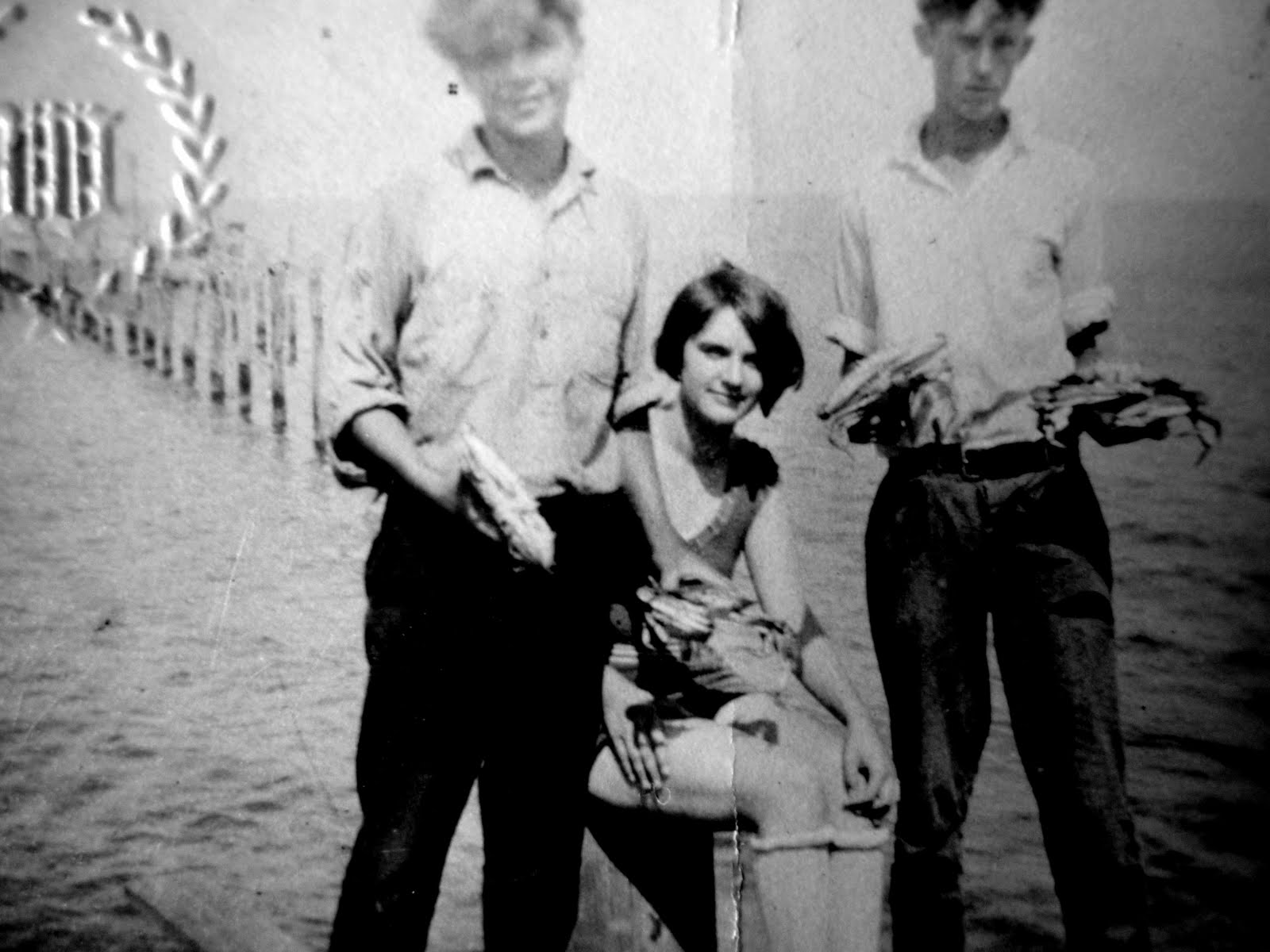
This blog violates a principle that I hold close, that is, not to be overly personal -- this blog-site is supposed to be about photographs. This particular blog is, I think necessarily, more personal although it does pretend to be about photographs. Old ones. Family ones. The reader will find, worthy or not, that I interject myself often; these, after all, are photos that have helped me to to reexamine aspects of my father so are inherently personal. My thoughts may be distracting; if that is so the reader should just enjoy the photographs.
My father died in 1983 at age 72. Congestive heart failure got him after 38 years of smoking Camel cigarettes and working at International Paper Co. in carcinogenic air. His funeral wake was attended by many work friends (he was a welder until he retired) and family and other close friends . I heard many stories about him, most emphasizing that he was a good man and liked by all. There was the usual stuff: that he loved me, my mother. How much of this was true I'm not entirely sure, but I chose to believe it. After weeks of looking at old photographs of him and his friends I am more confident that he was a well-liked man, and one more complicated than I knew.

At the age of 18 do many young people know their parents in a meaningful way? Perhaps. As for myself at 18, and leaving home for university, I feel that much more could have been known. My mother died at age 52 while I was in graduate school thereby eliminating any chance to know her as a mature son might. My father I rarely saw after leaving home; sure there were the occasional weekends and holiday visits, but these, often as not, were spent with young friends not with parents. The deeper knowing that one might want as an adult falls short of its potential.
So, when I opened a box of old photographs a few weeks ago I was pleasantly surprised, and gradually became enamored of its contents. The box had been a possession for years, but went unopened and neglected. It had been stored in Tuscaloosa, Alabama and then was shipped to me in Guatemala along with a collection of negatives and photo prints that I had made over two decades. The badly worn box hardly caught my attention initially, but once it was opened it opened a door on my family life.
My father was to me, in early years, an awesome figure. He was a large man, usually weighing about 190 pounds, sometimes as much as 210, and he was five-feet, 10-inches tall. He was called "Boots," a nickname he was given as a child, a child who only wanted to wear boots. He was much given to smiling, but had gruff manner as well. He was also given to foul language, particularly when working; a bent nail, a screw that would not turn, a miss-cut board and his profanity exploded. God-damned cheap nails, screws and screwdrivers made by sorry ass Japs, and lumber that was insufficiently dry or of poor quality were the principal recipients of his anger. He never cursed me. He never cursed my mother. He was prone to curse salesmen, in their absence,who were often sorry-assed humans whom he would plan to give hell at the first opportunity: that opportunity never came. At any encounter with a sorry-ass salesman, or other sorry-ass human, he became pure reason and politeness. Such was his character.

The eyes and the smile of this child never changed. Seeing my father with a small cloth doll and dressed in white finery and striped socks both shocks and moves me emotionally. I notice right away that he has fingers on his right hand, fingers, three of which, will be lost when he is a few years older. This photograph, obviously kept by his mother, is the treasure of my collection. Happy child, contented adult.
 Boots (right) with his brother, Bill.
A close examination of the photograph above will show that my father has only two fingers on his right hand. Three fingers were mangled in a circular saw in my grandfather's lumber mill. A twelve hour winter-time trip across a frozen bay to find a doctor was definitive, he lost the fingers and their loss clearly had an impact on his life. However, he never complained and he never believed there was manual labor that he could not do and do well. This was a correct assessment. He was a first-class welder, plumber, carpenter, and much more. He was, in fact, proud that he was so entirely capable sans fingers. His grip in his right hand, he would happily demonstrate, was exceptionally powerful: I saw more than one man groan in agony when testing my father's handshake. I learned early on that when he put his two fingers around my arm that I was in for some pain.
Boots with his Stutz Bearcat
Boots told me, when I was a teenager and much interested in automobiles, that he had owned a Stutz Bearcat. He owned it as a young man and only reluctantly sold it, if my memory is correct. I have always had the impression that, though he owned five or six automobiles over the years, that the Stutz was his favorite. Not knowing what a Stutz was I was pleased to find photographs of him sitting or standing near his. In more than one instance with a pretty girl; hard to know which was more important, the car or the pretty girl. I made an effort to learn something about the Stutz. The most interesting fact was that it was an early sports car and was desirable in its time. Today one can be purchased for $250,000 and up; my father would be pleased with that fact.

 Boots (left) with unknown girl and boy
Boots' favorite past-time was fishing. I recall many unpleasant hours sitting in a boat with him waiting for the fish to start biting as they were sure to do. Why do I say unpleasant? I don't think many seven and eight year-olds find sitting absolutely quiet in a wooden boat (any movement made thumping sounds that frightened away the fish) for hours on end holding a cane pole, watching still water, a quietude that many adults would find Zen-like, (who knew the word then?) inspirational. The photo here confirms his early love for the sport, one which he never relinquished.

With fishing came boat-building. Our back yard was the scene extraordinary construction projects. Small boats, large boats. Prior to Mardi Gras one year he agreed to help construct a parade float and he over-saw the construction in our side yard. Near to the construction "site" he thought it a good idea to build a storage and work building. This building, made of scrap lumber and used tin roofing was quickly cobbled together. Within a year it was full to the top with salvaged materials. Used railroad ties, buckets of rusting nails, huge rolls of craft paper brought home from the mill, broken -- but always fixable! -- electric motors, sheets of stainless steel. Nothing went unappreciated for its potential use at some indefinite time in the future: it was never used. Anything at the mill that could fit into a metal lunch pail was likely to find its way to our shed.
The work shed, as it was called, became so full that it was not possible to enter it. We would stand in the doorway while he tried to recall exactly where he had put the perfect broken water pump that "we" could refurbish and put to use: the smallest most agile person, namely me, would then crawl over the top of his treasures and dig down until it was, sometimes, found. My father's shed was a bitter pill for mother, but it endured. She, too.
 Boots, me, mother
The boat shown above was just one of the boats that my father owned over the years. This one he built. It was transported, unfinished, to our fishing camp in Mississippi where he planned to finish its interior. It was meant to be used for fishing in the creeks and rivers nearby. It quickly became apparent that it was unwieldy in the extreme with the small 18 horsepower outboard motor that he bought. It sat beached for years, unfinished still, near our boat dock. It was never used after the first four outings. It became a play-boat for children and their secret gender discoveries which naturally led to "you children have to stay out of that boat."
Boats were not the only things that Boots built. I can recall no time when he didn't have something under construction, or planned. Plans, of course, out numbered actual finished projects by about ten to one. We built a camp. We built a small house for my grandmother behind our house; and had to walk around the shed to get to it. Of most interest to him were items that he could weld. My mother wanted two sizable pans for frying fish at the camp. Not one to waste money when he could make them he made two of heavy industrial stainless steel. One shallow and about two feet in diameter. The deeper one was of equal diameter but two feet deep. Each weighed nearly 12 pounds, used gallons of oil and couldn't be lifted by my mother from a stove without assistance. Not to worry. He built an out door cooker, again stainless and fired by a propane gas tank, all of which had to be hauled into place from the locked closet where it had to be stored. Because our camp was on a creek I thought I needed some sort of spear gun. Buying one was never considered, Boots made one. It had a hollow metal tube, and the necessary spear, also solid metal. The trigger mechanism was bent steel. Propulsion was by a length of surgical rubber which when expanded provided the force for the spear. It worked as planned except that the spear was so heavy that its effective range was about four feet. The combined weight of gun and spear was such that it pulled me quickly to the bottom of the creek and then came the struggle to get back to the surface. Like many brilliantly conceived things it went unused.
. Boots and myself at the fishing camp in Mississippi. He is attempting to prime a hand pump on a well that we, with the help of friends, drove 60 feet deep using a heavy weight suspended from a cross beam and pulley.
 Boots (right) with banjo. I'm puzzled that he was able to play with only two fingers on his right hand. Three fingers, as mentioned above, were lost during a childhood mishap.
Boots, I was told a few times by people who knew him in his youth, was a ladies-man. Not a Lothario, not a cad, not womanizer I was assured. Nonetheless, I found this description not to be credible. Perhaps it was due to my perceptions of him at home. A man who left early (5 am) to drive to work, who returned at 3:30 each afternoon and soon settled in front of the television. We ate as a family, watched television the same way, though what we watched was his choice. Almost without exception he would fall asleep in front of the TV about 7:00 and arouse himself to go to bed 10:00 pm. I had a difficult time imagining how someone with his lack of interest in social affairs and, it seemed to me then, sluggish and lethargic character could have ever been of interest to girls, or women.
Photographs, as some say, tell the truth (we can avoid, here, whether this is true) and, in the matter of my father, I think they do get to something significant about him. In my box of photographs the largest number of any person were of my father, no doubt saved by his mother, then by mine. Of those of him, many were of him with his arm around some beautiful girl, or with her arm around him. None of the photos of these beauties has a name or date on it. But in the context of other photos it would appear that these were all made sometime between the mid 1920s and 1930s. They are photos of a happy man with happy girl-friends. They confirm for the skeptical me that he was indeed a man who loved women. He must have been thought a "catch" -- as were the women that he was photographed with. Judge for yourself.
This part of Boot's life came to an end when he met my mother, a young woman of beauty herself, whose beauty clearly rivaled that of earlier women. Meeting and marrying Wilmoth Odom was the most important moment in his life. (Certainly in mine.) And while an earlier version of Boots seems to have disappeared he seems never lost his charm entirely.
After my mother's death at age 52 a number of his old flames began contacting him. (I know this because I was temporarily living with him.) They would drop by the house, bringing gifts of food and assurances that they were available if he needed a shoulder to lean on. He dated a few of these women: I recall him arriving home at 2 o'clock in the morning, then leaving again later to go to work. This went on for months. Nothing came of it. A few years later he married again, but not to an old flame. The new Mrs. Waters was a widow with a home, a daughter, and not the least needy, in the sense we use that word today. This new life, as far as I could tell, was unexceptional: he returned to his first-marriage-ways.


 Below: photographs of my mother, my mother and me, Boots and her (to his right) at a gala, and her with a very mysterious smile.


 The finca Patzibir: No homes remain. The landslide, water, mud, stones began about one-half mile away on volcano Toliman. The rubble followed a riverbed and covered the highway, washed out bridges, and completely covered all the small homes near the finca. Only the finca's coffee drying shed and a small church survived.


 Don Pedro: His home, about a half-mile away, survived. Today he gathered wood and talked with two curious gringos.
 Two young women in the bottom of a deep river bed are looking for a way to the top. They are carrying plastic containers for water.
 This gentleman, with hammer and small chiesel says he will break this stone into smaller pieces; he thinks it will take him about six weeks.
 Same optimistic man with stone.